High Availability or Failover
When Using SmarterMail
SmarterMail is an ideal solution for environments where reliability is essential. SmarterMail High Availability (HA) is a clustering solution that allows mailboxes to be distributed across multiple SmarterMail “nodes,” enabling virtually unlimited scalability, while SmarterMail Enterprise can be used in failover scenarios to provide redundancy. Both options provide unparalleled resiliency, and which solution you choose is up to which is the best fit for your needs.
SmarterMail High Availability (HA)
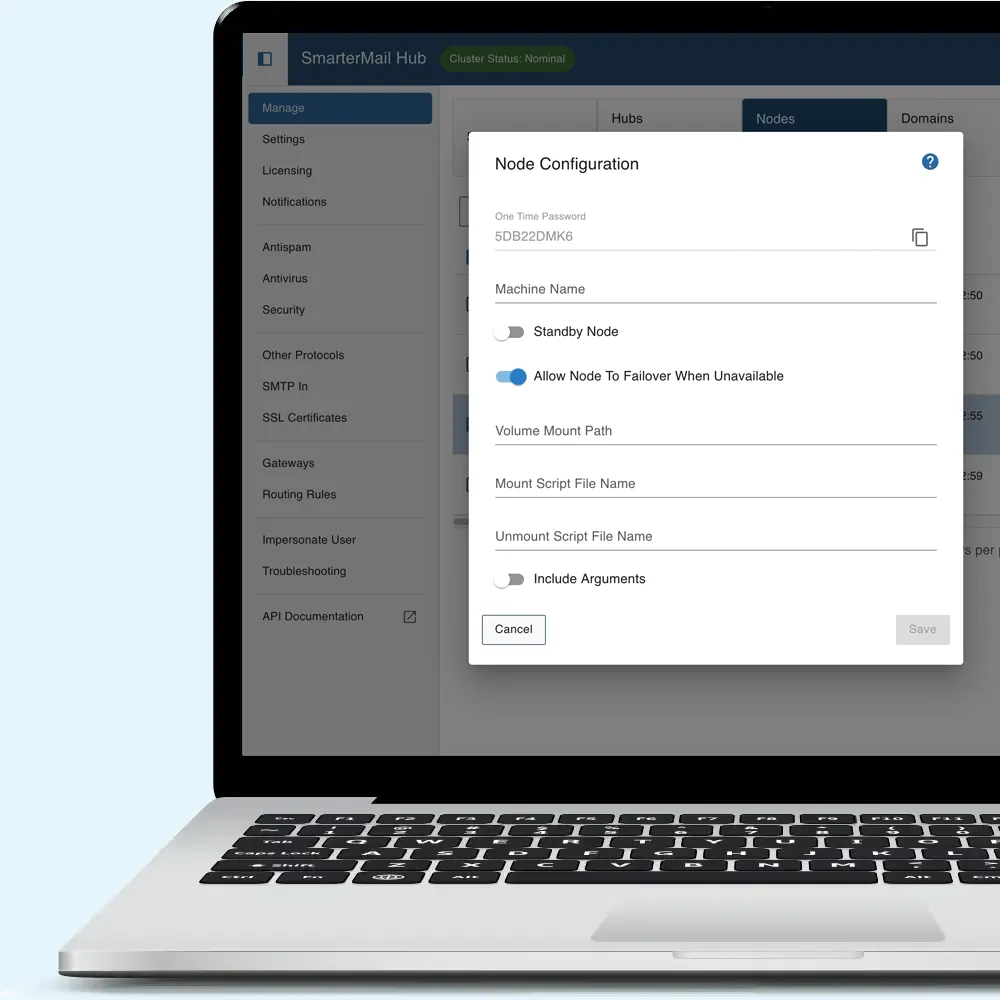
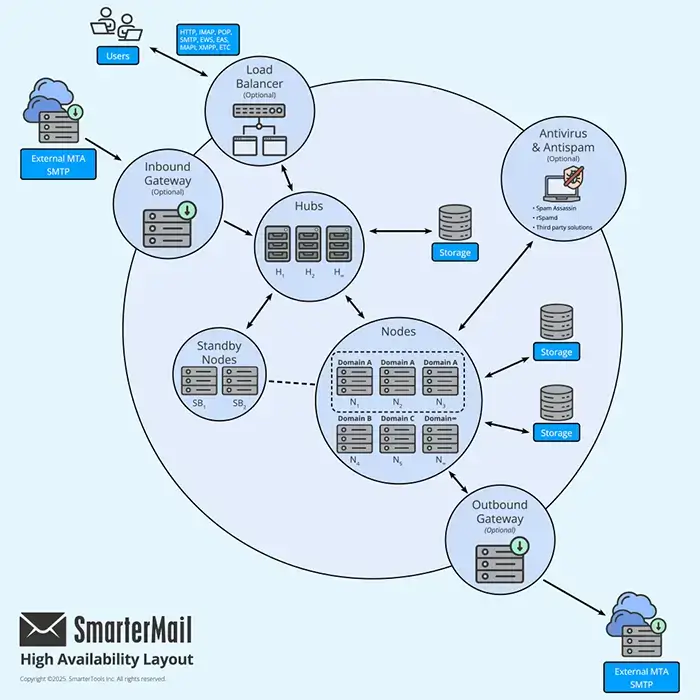
SmarterMail HA is a fully licensed version of SmarterMail, available for both Linux and Windows. It allows administrators to build a SmarterMail cluster consisting of a network of hubs, nodes, and shared storage (SAN, NAS, local shares, etc.), all managed from a hub to review performance metrics, monitor cluster health, and greatly simplify large-scale email environments.
SmarterMail HA was built to offer a scalable solution, whether for a single domain with a million users or a million domains with their own allotment of users. In either scenario, you start with the number of users and domains you need today and then grow as needed. Most importantly, you only pay for what you need in the moment.
For more information, see our SmarterMail HA Overview page.
Benefits of SmarterMail HA
- Scales effortlessly up to millions of users and domains.
- True clustering with built-in fault tolerance for maximum uptime.
- Flexible domain distribution, including splitting a single domain across multiple nodes .
- Monthly licensing model with MAPI & EWS included for Exchange-level desktop synchronization.
- EAS Flex Billing (monthly) across the entire cluster for seamless mobile synchronization .
- Cross-platform support for both Linux and Windows environments.
- Flexible deployment options: VMware, Docker, Kubernetes, bare metal, and more.
- Easily scale infrastructure by adding or removing hubs and nodes as needed.
- Extend functionality with additional components such as gateways and security appliances .
- Centralized management hub for distributing settings across your cluster, and monitoring the performance and overall health of the cluster.
Who is it for?
- Businesses and enterprise organizations that require unparalleled uptime and reliability .
- Hosting providers and ISPs managing thousands of domains and tens of thousands of users .
- Organizations with a single domain that need to support virtually unlimited users.
- Email hosting providers offering free email services at scale.

SmarterMail Enterprise With Failover
A SmarterMail Enterprise license is all that is required to enable failover, but it does require a properly configured virtualized environment. A secondary server can run the same license as the primary; however, it operates as a cold standby, meaning it remains offline while the primary server is running.
As with High Availability (HA), a failover configuration requires centralized storage to hold all server, domain, and user settings, as well as email data. This ensures both servers have access to the same data if one becomes unavailable.
If the primary server goes down, the secondary server can be brought online—either manually or automatically via script—and will resume mail processing.
For more information, see Configuring SmarterMail for Failover in our help documentation.
Benefits of Failover
- Ideal for small to mid-sized deployments seeking reliable redundancy.
- Single license usable across two servers (primary and standby).
- Cross-platform support for both Linux and Windows environments.
- Utilizes failover functionality of your existing virtualized environment (Vmware, Docker, ProxMox etc.).
- Supports both manual and automated failover.
- Allows for geographically diverse, redundant datacenter configurations.
- Easily extendable with additional components (e.g., gateways, security appliances).
Who is it for?
- Organizations with a limited number of domains and users that need improved uptime.
- Businesses seeking a simple, cost-effective redundancy solution for their email platform .
- Companies requiring geographically distributed failover for added resilience.